
🍩 | Dozen Data-Driven Dispatches from Possible 2026
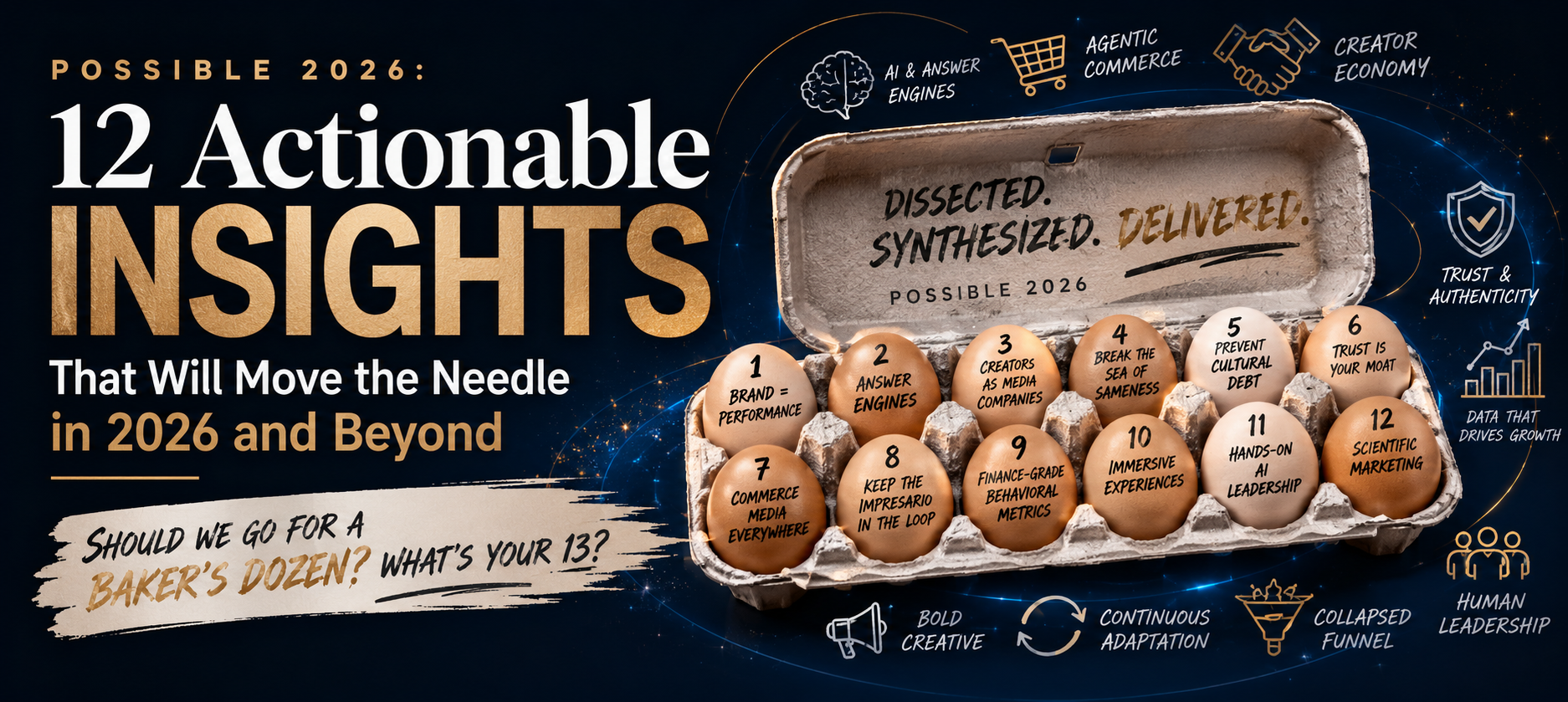
Source: Author, Possible 2026, ChatGPT, Claude, Google, Fathom, Plaude & Friends
There's 12 months in the year, 12 donuts in a box, 12 eggs in a carton, 12 days of Christmas — and now, 12 actionable insights I / we gleaned from Possible 2026. But before you dive in, here's what makes this list different. This isn't a simple recap. What you're about to read is a synthesis — the sharpest thought leaders from the Possible stage, my own industry intuition, declared data from across the internet, and my custom Google NotebookLM built specifically around the conference. I didn't just attend Possible 2026. I dissected it.
Consider these 12 insights my gift to you. A shortcut to the ideas that will actually move the needle in 2026 and beyond.
1. Erase the Divide Between Brand and Performance Marketing
The debate between brand and performance marketing is over. It was always the wrong fight. Brand-building is a performance driver — full stop. Longitudinal studies prove it generates five times the revenue of short-term campaign sales. Consumers built through brand favorability cost 85% less to acquire. They also deliver higher lifetime value. The new mandate? Secure finance-grade metrics. Align with your CFO. Treat brand as a quantifiable engine for long-term growth.
2. Optimize for Answer Engines and Agentic Commerce
Search engine optimization is no longer enough. Consumers and AI agents are moving to "answer engines." These tools collapse discovery into a single, conversational response. Personal AI assistants — sometimes called "claws" — are already browsing, researching, and buying on behalf of users. The old metric was share of mind. The new metric is share of prompt. Structure your data to be AI-discoverable. Build verified trust signals. AI agents will ruthlessly filter out anyone who doesn't.
3. Treat Creators as Strategic Media Companies, Not Content Vendors
Influencer marketing is dead. Creator partnerships are what's alive. Top creators aren't just making content — they're running trusted media companies with deeply loyal communities. Rigid briefs with mandatory talking points? They kill results. Instead, fund creators' passion projects. Give them total creative freedom. Let them integrate your product authentically. Respect their audience relationship and they'll deliver something no brief ever could.
4. Fight the "Sea of Sameness" with Purposeful Cognitive Dissonance
Right now, 50% of all emotional responses to U.S. ads are "nothing at all." Nothing. That's the real crisis in marketing. Being ignored is more expensive than being controversial. The answer is purposeful cognitive dissonance — creative risks that stop people cold and force them to look twice. JCPenney removed its own logo to challenge brand bias. Tubi ran a Super Bowl ad that looked like a TV glitch. Bold moves. Unforgettable results. The risk isn't being provocative. The risk is being invisible.
5. Prevent "Cultural Debt" by Fostering Continuous Adaptation
Everyone understands technical debt. But cultural debt is the real silent killer. It's the cost of outdated mindsets, rigid behaviors, and people systems that can't keep up with AI. Treating AI adoption as a one-time change management project will fail. New tools drop every single day. The only solution is a culture of continuous adaptation. Give employees time to sandbox new tools. Run human-in-the-loop evaluations. Correct and refine AI outputs constantly. This isn't a project. It's a new way of operating.
6. Leverage Trust and Authenticity as Your Ultimate Moat
AI makes content generation effortless. That's exactly the problem. As synthetic media floods the internet, consumers will default to distrust. In that world, verified human authenticity becomes your most powerful differentiator. AT&T said it best: "Customer trust is not for sale." Be transparent about how you use data. Keep human judgment at the center of your brand's emotional connection. In an AI-saturated landscape, realness is the rarest currency.
7. Collapse the Funnel Through Commerce Media
The traditional marketing funnel is gone. Discovery, consideration, and purchase now happen simultaneously. All media is converging into commerce media. The fuel driving it? Deterministic purchase data. Not guesses. Not proxies. Verified proof of consumer intent — like knowing someone buys coffee every single day. Use that data to make every touchpoint shoppable. TV ads. Social live streams. All of it. The shorter the distance between inspiration and purchase, the better.
8. Keep the "Impresario" in the Loop
AI is the Stradivarius of marketing. But a violin cannot play itself. It needs an impresario — a human with vision, taste, and the courage to challenge the status quo. AI lowers the barrier to execution. It amplifies existing talent. But it cannot supply original ideas. It cannot feel what's missing. Over-rely on it and you'll find that AI raises the floor for efficiency but lowers the ceiling for collective novelty. Human excellence will only become more valuable. Don't outsource it.
9. Align on Behavioral, Finance-Grade Metrics
"Brand love" won't get you through a budget meeting. Vanity metrics are finished. The C-suite wants behavioral proof. Look at Coca-Cola. They ditched fuzzy sentiment scores and built their strategy around "Weekly Plus" — tracking whether a consumer buys their product at least once a week for 52 consecutive weeks. That's a metric with teeth. Align your entire marketing ecosystem around verifiable business outcomes. That's how CMOs stop being cost centers and start being growth drivers.
10. Architect Immersive, Multi-Channel Product Experiences
A 30-second ad isn't enough anymore. Consumer attention is too fractured. Too contested. The brands winning today are turning campaigns into experiences. Take Salesforce and Mr. Beast. They transformed a Super Bowl spot into a 7-week, AI-powered treasure hunt. Slack was embedded directly into the campaign itself. Passionate fan communities collaborated to solve it. The result? Hundreds of millions of deep, active engagements. Not passive views. Not impressions. Real participation.
11. Demand "Hands-On" AI Leadership
The single biggest predictor of AI success in an enterprise? Whether the decision-maker actually uses the technology themselves. Not delegates it. Uses it. Leaders with hands-on AI experience can bypass organizational barriers. They scale evidence instead of waiting for permission. Don't just sponsor AI initiatives from the boardroom. Get in the tools. Vibe code. Test prompts. You cannot lead what you don't understand.
12. Join the "Rebel Alliance" of Scientific Marketing
Marketing has a credibility problem in the C-suite. It's earned. For too long, the discipline leaned on opinions instead of evidence. That era is over. The brands winning in 2026 are treating marketing like a science. Here's what the data actually says: promotions steal customers — they don't grow categories. Distribution has 67 times the sales impact of advertising. These aren't opinions. They're undeniable truths. Build your strategy around them and marketing becomes a predictable engine for enterprise growth.
Should we go for a baker's dozen? What's your 13?
