
🏪 | CPG Innovation Playbook: 12 Mega-Trends Redefining the Industry
As many of you know, I love AI.
I’ve started building conference-specific AI agents that synthesize thought leadership sessions, discussions, and publicly available data. Everything from press releases, pitch decks to investor materials. The article below was created using my proprietary agent, powered by 52 high-quality data sources and a set of intentional prompts.
I’m not the first to say it, but AI is your friend, our friend. It’s becoming table stakes, and more importantly, it frees you up to focus on higher-value work.
With that said, enjoy! 👀👇🏼
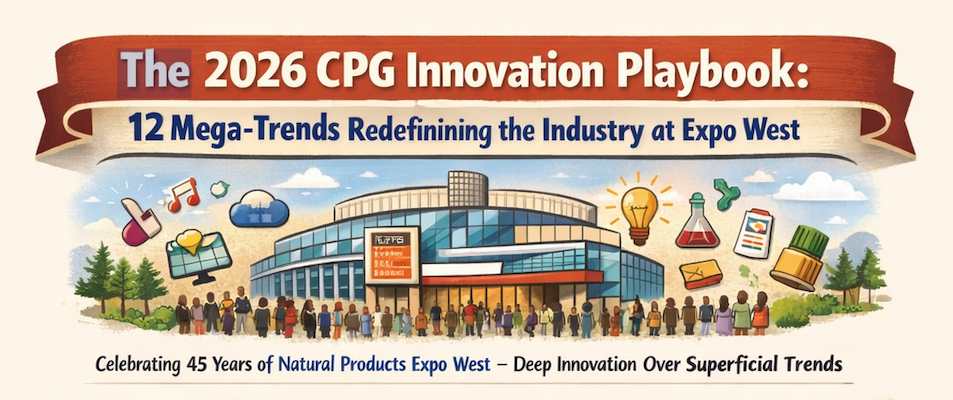
As we celebrate the 45th anniversary of Natural Products Expo West, it is clear that the consumer packaged goods (CPG) landscape is undergoing a profound transformation. The era of superficial line extensions and flashy flavor updates is over; today, the market demands deep, systemic innovation.
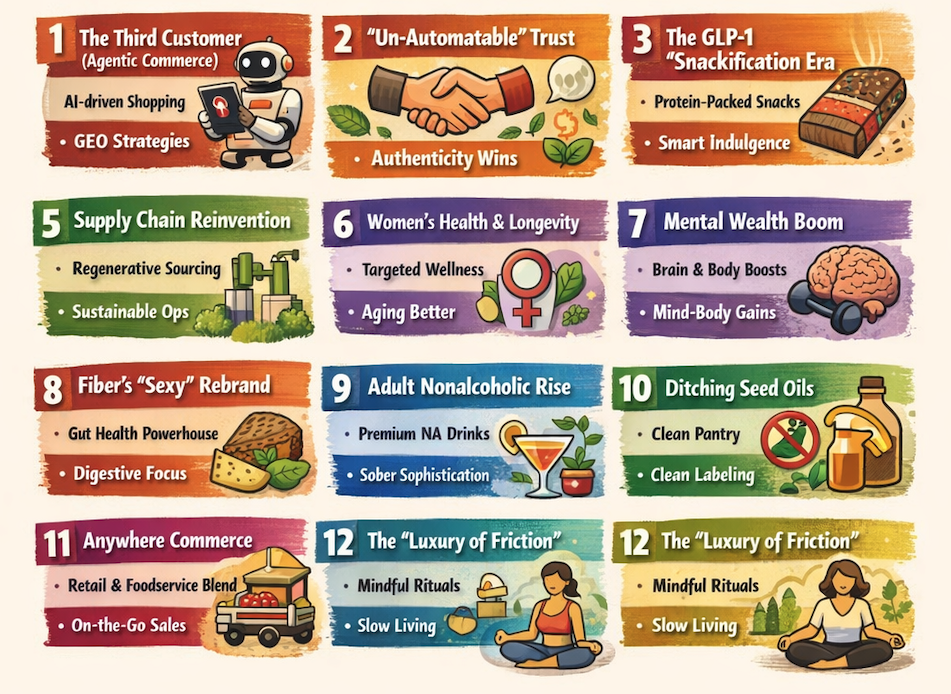
Here are the 12 most critical product innovation trends unpacked from Expo West 2026, alongside actionable strategies to help you build and scale your business around each insight.
1. Selling to "The Third Customer" (Agentic Commerce)
Your product is no longer discovered directly by people first; it is interpreted, filtered, summarized, and recommended by AI. Generative AI and agentic commerce platforms are becoming the primary filter layer between consumer intent and your Product Detail Page (PDP). By 2030, AI search is forecasted to increase from 10% to 65% of global search traffic, and 78% of consumers already used AI for shopping tasks this past holiday season.
Actionable Approach: Transition your marketing from keyword-stuffed SEO to Generative Engine Optimization (GEO). Restructure your PDPs to provide attribute-level clarity, explicitly listing certifications, use cases, and functional benefits so AI agents like Amazon's Rufus can accurately summarize and recommend your product for highly specific consumer queries.
2. "Un-Automatable" Trust as the Ultimate Moat
As AI reshapes commerce, it will also enable bad actors to manufacture fake "founder stories" and hyper-personalized marketing at scale. In response, consumers will develop an "authenticity trust radar" and reject automated pandering. Natural products companies that have spent decades prioritizing real ingredients and human connection are sitting on the most valuable asset in the AI economy: trust that cannot be automated.
Actionable Approach: Use AI to optimize your back-end workflows, but never use it to replace your human story. Double down on radical transparency and leverage third-party certifications to prove your claims.
3. The GLP-1 "Snackification" Era
The snacking industry is undergoing a massive shift driven by the rise of GLP-1 medications. These early adopters show high interest in personalized nutrition and are actively resetting their appetites. Yet, consumers still want "permissible indulgence," refusing to sacrifice taste for health.
Actionable Approach: Innovate within the "Snack-ro" (macros in snacks) space. Focus on smaller, nutrient-dense portion sizes that deliver high-quality protein and functional benefits without stripping away the indulgent flavor profiles consumers crave.
4. "Protein Palooza" & The Return to Tradition
Protein remains a major driver across all categories, appearing in everything from milk and coffee to cookies and sodas. However, there is a distinct evolution toward a "return to tradition" and whole-animal utilization. Beacon Discovery data shows a rising pipeline for ancestral protein blends, heritage meats, portable protein sticks, and pasture-raised eggs.
Actionable Approach: Simplify your ingredient panels. If it aligns with your brand values, embrace high-quality animal-based fats and traditional formats—like grass-fed beef sticks or clear whey beverages—to appeal to shoppers fatigued by ultra-processed meat alternatives.
5. Supply Chain as the Core Operating System
Meaningful innovation has moved deep into the supply chain and business operations. Post-pandemic, treating purpose as just a marketing layer is no longer viable; it must be your operating system. As one leader noted at the show, "Having a strong supply chain? That's not a trend. That's the job".
Actionable Approach: Shift R&D focus toward supply chain durability and regenerative agriculture. Build resilience into your brand by designing for right relationships with workers, communities, and suppliers, which protects both the planet and your unit economics.
6. Hyper-Targeted Women's Health & Longevity
Wellness is officially transitioning into longevity—shifting from living longer to living better, longer. This is evident in the women's health sector, which is moving past generic multivitamins to embrace nuanced positioning and clinical studies. Traditional ingredients are taking center stage, such as the Ayurvedic herb shatavari, which is tapped to support female fertility, vitality, and hormonal balance.
Actionable Approach: Niche down to scale up. Stop trying to serve every consumer at once; instead, find specific pockets of consumers—such as women navigating perimenopause—and formulate targeted, clinical-backed solutions specifically for them.
7. Mental Wealth & the Muscle-Brain Axis
Cognitive health is expanding rapidly beyond traditional pill formats. Mental wellness ingredients are moving into mainstream beverages, coffee, and snacks. Beacon data shows massive growth in this sector, including a 32x growth in adaptogen SKUs, alongside surges in creatine and mushroom products.
Actionable Approach: Practice "benefit stacking". Incorporate cognitive-supporting ingredients into everyday, accessible food and beverage formats to help consumers manage the high-speed data stream of modern life.
8. Fiber’s "Sexy" Rebrand
Fiber is experiencing a massive renaissance, growing 2.4x faster than protein in social conversations. It is being rebranded as a sexy, multi-benefit powerhouse for gut health, skin health, and menopause support, heavily featuring pre-, pro-, and post-biotics. Fiber-forward breads and baked goods are also trending as consumers look to pack healthier lunches.
Actionable Approach: Formulate proactive, fiber-fortified innovations across categories. Position these products around the active health goals they deliver (like digestion and satiety), which is especially vital for the growing GLP-1 demographic.
9. The Adult Nonalcoholic Boom
The nonalcoholic beverage category is broadening significantly. The movement has evolved past simple mocktails that just remove alcohol; at Expo West 2026, innovation was centered on canned cocktails and wellness tonics that bring sophisticated, adult flavor profiles to the booze-free bar.
Actionable Approach: Cater to mature palates. Formulate your nonalcoholic beverages with complex, savory, bitter, and herbal notes to provide a premium, functional alternative for adult social occasions.
10. Disrupting the Pantry & Eliminating Seed Oils
Consumers are aggressively seeking to avoid ultra-processed foods and certain ingredients, particularly seed oils. Data shows that products without seed oils are commanding a price premium ($4.36 base average retail price versus $4.32 for those with seed oils) and driving unit growth.
Actionable Approach: Audit your formulations and eliminate artificial ingredients and seed oils. Reinvigorate staple categories by emphasizing whole food ingredients and leading with clear, transparent labeling.
11. Anywhere Commerce & Hybrid Retail
The lines between retail and foodservice are blurring, creating an era of "anywhere commerce". Today, 63% of consumers discover food trends through prepared foods at grocery and convenience stores.
Actionable Approach: Break down your channel silos. Strategically blur the lines between retail and foodservice by placing your products in prepared food sections or experiential wellness zones, capturing consumers at the exact moment of discovery.
12. The "Luxury of Friction"
As technology and AI accelerate the pace of life, a counter-movement is emerging: The Luxury of Friction. Consumers are seeking "health hospitality" and offline wellness routines that encourage a "great slow down".
Actionable Approach: Position your personal care or wellness products as essential tools for intentional, offline rituals. Emphasize how your products help consumers disconnect, regulate their nervous systems, and reclaim their time away from screens
I hope you found some value in this content! And if you did, feel free to share it with your network. 🤜🏼
