
🧋 | How a Milkshake Inspired Channel M’s Reason for Existence (and continues too)
Source: Jeff Mard, Chat GPT, Claude, Christensen Institute
I’m sharing what makes Channel M so special.
It comes down to one idea: the Jobs To Be Done (JTBD) theory.
The late Clayton Christensen wrote my favorite business book, Competing Against Luck. His theory says people do not buy products. Much like a brand doesn’t hire an agency to make a website or launch campaign. They hire them to make progress on a job in their life. Solving unmet needs that (often) can’t be met with existing resources.
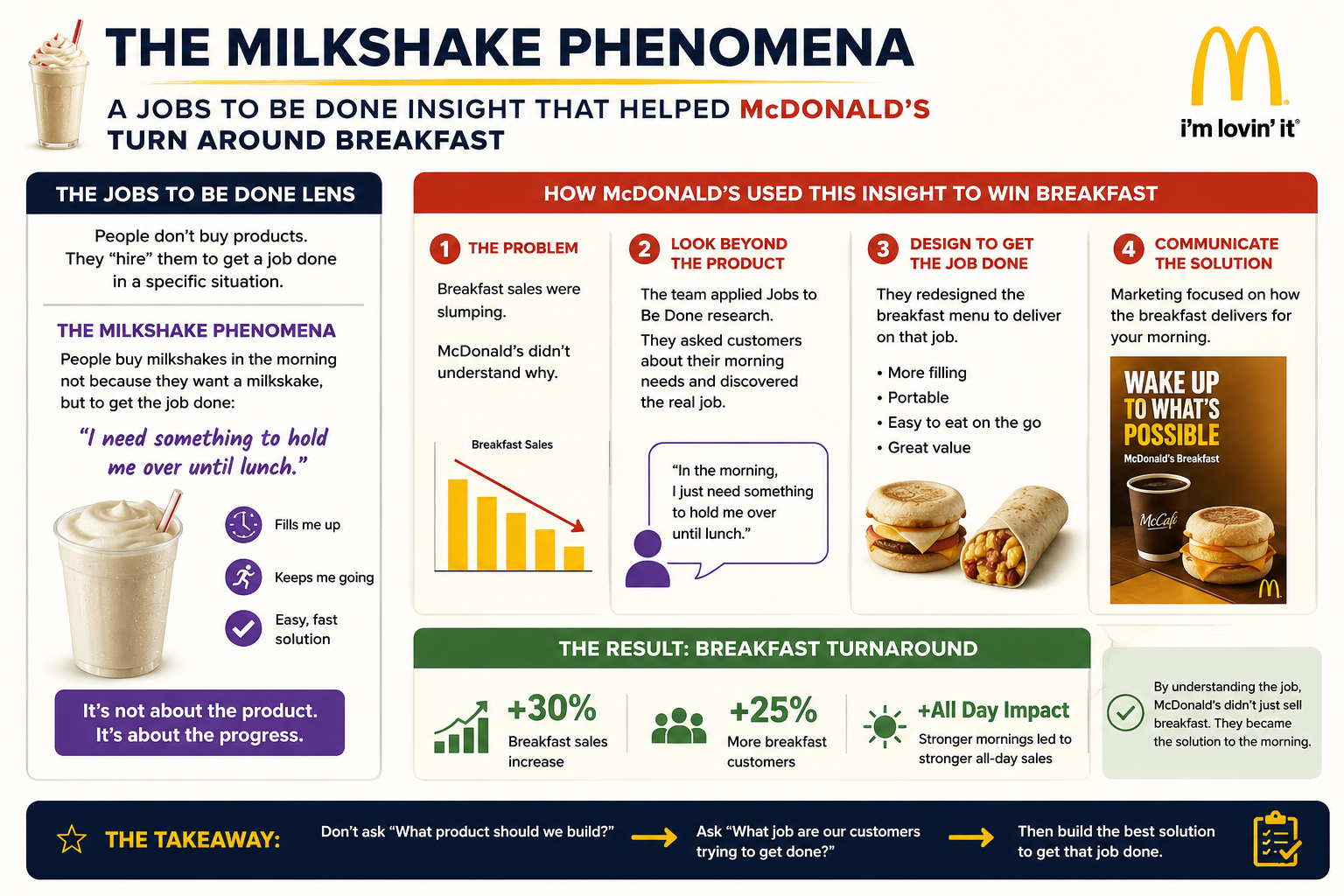
One of his famous examples is the McDonald’s milkshake.
Micky D’s sales were slumping during the breakfast day part. They turned to one of the most unlikely hero products, milkshakes. They had a theory…
They tried LTOs, new flavors, promotions and prices… got nowhere. Then they asked a better question. What job are people hiring us to do in the morning?
Turns out, morning commuters wanted something keep them busy on a long, boring drive. That held them over until lunch. The job was not "feed me." The job was "make my commute better." And definitely don’t make my car messy with crumbs.
The Milkshake is the reason Channel M exists. And works so well.
Brands, vendors, and agencies all have a job to be done.
They rarely need another vendor list. They need progress. They need the right partner, the right capital, or the right provider, matched to the real problem in front of them.
Most matchmaking gets this backwards. It pushes a network. I start with the job to be done.
I learn what you are actually trying to move forward. Then I bring vetted, qualified resources that fit. No bureaucracy. No bloat. Just the right connection at the speed of business.
I then (often) go to conferences to meet people where they are. Learning about about their unmet needs.
What is the unmet need(s) to solve for. Not more options. With a brand, I try to walk in their shoes and imagine what will help them make progress in business challenge that keeps them up at night.
Want to apply JTBD to your business, here’s a framework:
Step 1: Start with progress, not the product. Finish this sentence about your customer: “They’re trying to go from ___ to ___ in the moment when ___.” If you can’t, you’re selling features, not solving a job.
Step 2: Run “switch” interviews. The best data is in the story of a real purchase. Ask someone who recently bought: What was happening the day you decided you needed something? What did you try first? What finally pushed you to act? You’re reconstructing a timeline, hunting for the trigger. That moment the old way stopped working.
Step 3: Write the job statement. Use the format: “When [situation], I want to [motivation], so I can [outcome].” Example: “When I’m slammed and skipping lunch, I want something I can eat at my desk in two minutes, so I can power through without crashing at 3pm.” Specific situation, real motivation, clear outcome.
Step 4: Map the three dimensions. Every job has a functional layer (the practical task), an emotional layer (how they want to feel), and a social layer (how they want to be seen). Most products nail the functional and ignore the other two… that’s where you win or lose!
Step 5: Find what they’re really “hiring.” List every current solution, including: doing nothing, hacky workarounds, and competitors outside your category. That’s your true competitive set. The milkshake’s rival is / was a banana for many, remember.
Step 6: Map the four forces of switching. Why people change (or don’t): the push of their current frustration, the pull of your solution, the anxiety about switching, and the habit of what they do today. To win the job, amplify push and pull, and reduce anxiety and habit.
Step 7: Design and message around the job. Now every choice features: copy, onboarding, packaging. And gets one test: does this help them make the progress they hired us for? Cut anything that doesn’t help.
So here is my ask:
If you feel like your growth has plateaued, stagnated, or simply is not headed in the right direction, we can help. And when I say we, I mean myself and my dozen plus partners.
Together we solve some of the industry's greatest challenges in building long term, profitable businesses. If you have a job to be done, let's talk.
