
🧐 | The AI Workforce: A Shift to "Return on Intelligence"
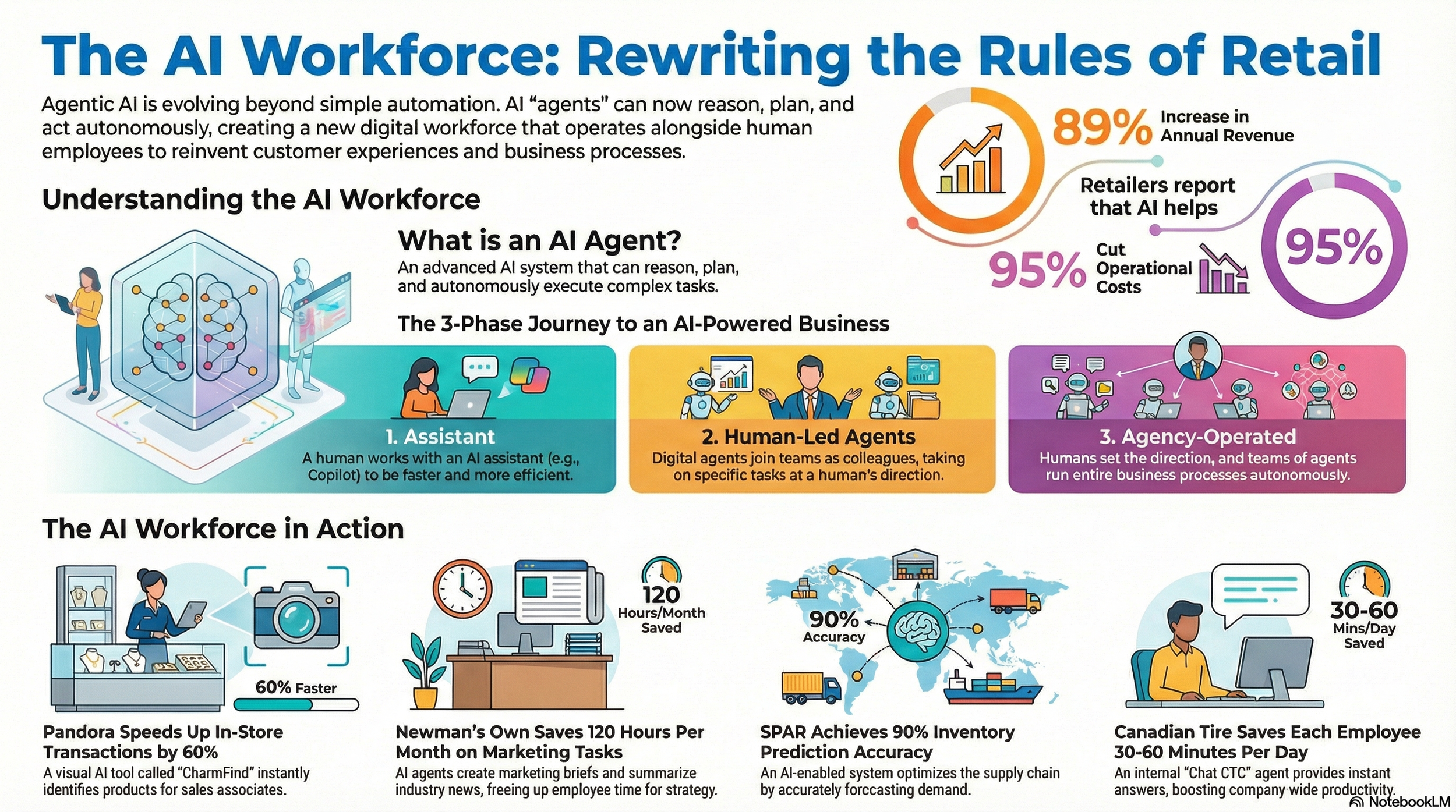
Source: Author + Google NotebookLM
This week at the National Retail Federation (NRF) show, the flagship gathering for global retail, one theme cut through the noise. AI is no longer about experimentation or efficiency gains alone. It’s about how intelligence itself becomes a returnable asset.
After days of sessions, conversations, and panels, one idea kept surfacing. The next era of retail will be defined not by how fast systems run, but by how well humans and machines think together. This blog is intended to be educational and pulls from the thought leaders at RETHINK Retail’s AI in Retail Conference. Enjoy these snack-sized strategies on how to approach AI within your organization.
The Shift to "Return on Intelligence"
For years, the retail narrative has been dominated by efficiency. Doing more with less. However, Keith Mercier, VP of Worldwide Retail & Consumer Goods at Microsoft, suggests a pivot in perspective. He argues that the true opportunity lies in "Return on Intelligence" (ROI), which centers on human ambition. While retail leaders expect productivity to increase, 80% of the workforce reports lacking the time and energy to meet those demands.
This capacity gap is where Agentic AI steps in. Mercier outlines a trajectory for the "Frontier Firm," moving through three distinct phases:
Copilots: Humans working with an assistant (the current standard).
Digital Colleagues: Agents joining teams to handle specific tasks.
Agent-Operated: Humans set the direction, and agents run entire business processes, checking in only as needed.
This creates a future where a CFO might approve a headcount of ten new hires, with the stipulation that five are humans and five are AI agents, fundamentally changing how resources are allocated.
The New Digital Workforce
A recurring theme among the experts is the necessity of treating AI not as IT infrastructure, but as a new class of employee. Mariya Zorotovich, General Manager of Consumer Industries at Intel, emphasized that deploying Agentic AI requires an onboarding mindset. Just as a manager wouldn't give a new hire massive responsibility on day one, retailers must introduce AI agents to the team, test them, and build confidence in their outputs over a 90-day period.
This "digital workforce" is already proving its worth in high-friction environments. At Pandora, Detria Courtalis, VP of Sales, shared how the brand launched "Charm Find," a mobile POS tool that uses visual identification to recognize products instantly. This replaced the antiquated process of associates flipping through binders to find SKUs, speeding up transactions and allowing staff to focus on "fan engagement" rather than logistics.
Similarly, Scott Matza, Head of Product at KWI, noted that while AI will not replace jobs, it will replace specific functionalities. By speeding up transactions by 60%, AI allows associates to elevate the human element of the sale.
Rewiring the Path to Purchase
The impact of Agentic AI extends outward to the customer, driving what Anne-Claire Baschet, Chief AI & Data Officer at Mirakl, calls a "shopper-led revolution." The search bar, a staple of e-commerce for decades, is being reimagined. Consumers are moving away from keywords (e.g., "running shoes") to expressing complex problems (e.g., "I need shoes for a marathon training plan"). Agents can now interpret this intent and curate solutions across a retailer's ecosystem.
This shift requires a massive velocity of content. Doug Tallmadge, CEO at Gradial, highlighted that AI is enabling marketing teams to produce campaigns 10 times faster, allowing for hyper-personalized content that legacy manual processes simply could not support.
However, this speed and autonomy rely heavily on trust. In a striking insight shared at the gala, it was noted that some consumers now trust ChatGPT recommendations 1.5 times more than they trust their own friends. This places a heavy burden on retailers to "get their data house in order," ensuring that the product data feeding these agents is pristine. As Sanjeev Siotia, CTO at Manhattan Associates, warned, "Agents don’t succeed in chaos."
The Future of the Agentic Enterprise
Looking forward, the integration of these agents will create a "Frontier Firm" where different AI agents collaborate. Imagine an inventory agent noticing a sales dip might autonomously signal a marketing agent to draft a promotional brief. This interconnectedness promises to resolve the "pilot purgatory" many companies face, moving from isolated experiments to scalable, revenue-generating operations.
As we stand on the precipice of this change, the consensus from the RETHINK Retail experts is clear: The technology is ready, but the human element remains critical. The goal is not to remove the human touch, but to use "Return on Intelligence" to remove the drudgery, liberating human workers to focus on creativity, strategy, and connection.
An Analogy for Understanding Agentic AI
To better understand this shift, imagine the retail industry’s relationship with technology like a busy executive kitchen.
In the past (Traditional Automation), the chef had a food processor. It was a powerful tool, but it sat on the counter and did nothing until the chef pushed a button. It sped up chopping, but the chef still had to do all the thinking, planning, and button-pushing.
Now, with Agentic AI, the chef has hired a sous-chef. You don't tell the sous-chef "push this button." You say, "We have a VIP dinner tonight, prep the stations for the steak menu." The sous-chef (Agent) looks at the inventory, realizes you are low on potatoes, orders them autonomously, preps the ingredients, and only bothers the head chef if there is a crisis. The head chef (the human) is no longer chopping vegetables; they are designing the menu and tasting the sauce.
The industry is moving from buying better food processors to hiring competent sous-chefs.
NRF made one thing clear. Retail is not being rebuilt around technology. It is being rebuilt around people who are finally supported by it.
Key Takeaway
Agentic AI is not the headline. Human potential is. Retailers who win will be the ones who design for trust, clarity, and collaboration firs. They let intelligence compound from there.
This isn’t the end of the retail story. It’s the moment the industry stops testing tools and starts building teammates. 🫱🏼🫲🏻
