
🫶 | The Perception Paradox: Bridging the Gap in Veterinary Care
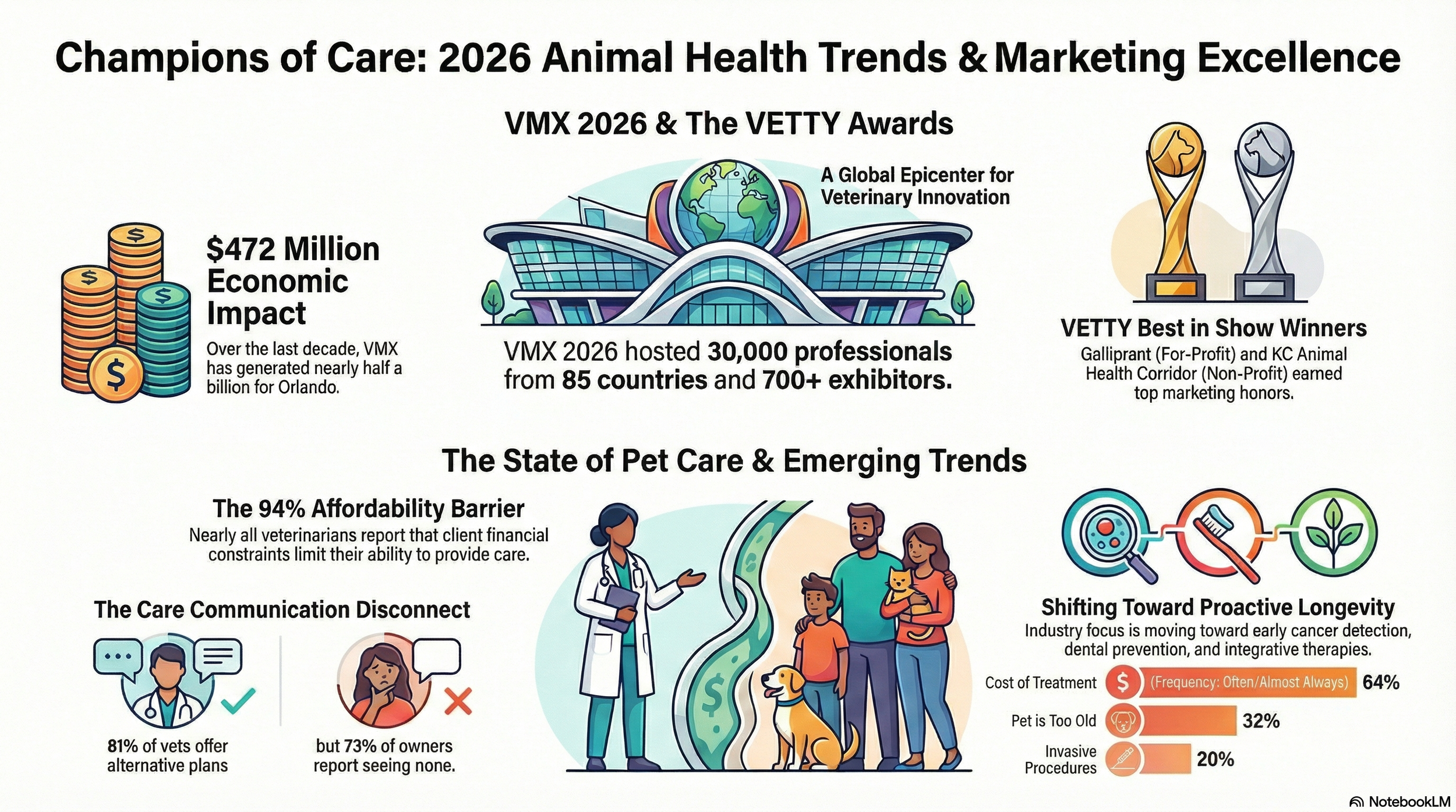
The animal health industry is booming, evidenced by a $100 billion global market and record-breaking attendance of nearly 30,000 professionals at VMX 2026. However, beneath the surface of this economic success lies a critical disconnect. A "constellation of disconnected systems" between pet parents, veterinarians, and the industry at large.
For brands and practices entering this space, success is no longer just about clinical efficacy; it is about communication efficacy. A review of the latest industry data reveals specific metrics that highlight deep fissures in trust and understanding. By analyzing these numbers, businesses can identify urgent needs and deploy targeted marketing solutions to gain a competitive advantage.
1. The "Spectrum of Care" Disconnect
The Metric: A recent PetSmart Charities and Gallup study uncovers a startling perception gap: 81% of veterinarians claim they often or always recommend alternative treatment plans when cost is an issue. Conversely, 73% of pet parents who declined care due to affordability report they were never offered a more accessible option.
The Business Need: This gap represents lost revenue and compromised animal welfare. When clients believe there is only a "gold standard" option they cannot afford, they walk away, leaving the veterinary practice with lost compliance and the pet with untreated conditions. The friction is not purely financial; it is a failure of translation.
Marketing Solution: Brands must pivot from marketing products solely based on "best-in-class" efficacy to marketing accessible solutions that fit a "Spectrum of Care."
For Clinics: Implement exam room signage and digital checklists that explicitly list "Good, Better, Best" treatment options. Marketing materials should standardize the language of "incremental care," validating that "trying something is better than not doing anything," a sentiment 92% of vets already agree with.
For Pharma & Industry: Create educational assets that train veterinarians on how to present these options without feeling they are compromising their medical standards. Brands that provide "financial communication toolkits" will build deeper loyalty with vet teams who feel ill-equipped (48% of vets say their education did not prepare them for financial conversations).
2. The "Financial Gain" Myth vs. Compassion Fatigue
The Metric: While clients often suspect veterinarians recommend procedures for profit, 73% of veterinarians find it emotionally difficult to watch clients struggle with costs, and 74% cite euthanizing a pet for financial reasons as one of the hardest parts of their job.
The Business Need: The "profit-motive" misconception erodes client trust and contributes to the high burnout rate among veterinary professionals. A practice cannot thrive if its clients are skeptical of its motives and its staff is suffering from compassion fatigue.
Marketing Solution: Marketing must humanize the veterinary profession to dismantle the "Financial Gain" myth.
Narrative Campaigns: Brands should emulate the storytelling seen in VETTY Award winners like "Galliprant – Playing with Fire" or "Leave Mo Behind.” Content should focus on the veterinarian’s "why." The oath they took to save lives, not just the science they practice.
Transparency Marketing: Clinics should use social media to explain the "behind-the-scenes" costs of care (e.g., equipment, specialized staff) to realign client expectations. This shifts the narrative from "price gouging" to "value for service."
Preventative Care Campaigns: Leverage content to create conversations around the importance of long-term health spurred by regular preventative care. Bring this to life through encouraging parents to have a dental plan in place.
3. The "Toddler-Proof" Knowledge Gap
The Metric: Toxicology calls are shifting. While chocolate remains the number one toxin, there is a rise in cases involving Xylitol (found in "boutique brands" of peanut butter) and THC. Crucially, experts note that "things that are child-proof are not dog-proof," as canine teeth can breach containers safe for children.
The Business Need: Preventative safety is a massive, under-served market. The increase in pet toxicity cases suggests that current safety labeling and education are failing to reach the modern pet owner, particularly regarding new entrants like CBD and synthetic cannabinoids.
Marketing Solution: Brands can position themselves as partners in safety through specific, actionable content marketing.
Toddler-Proof vs. Dog-Proof" Campaigns: Create visual guides for the home that highlight the difference between child safety and pet safety.
Ingredient Awareness: Food and supplement brands should aggressively market their "Xylitol-free" or "THC-free" status as a primary value proposition, educating consumers that "boutique" does not always mean "safe."
Real-Time Verification: Tech startups have an opportunity to develop apps or scanning tools that allow owners to instantly check products for hidden toxins like Xylitol before purchase.
4. Validating the "Whimsical": The Science of Integrative Care
The Metric: Integrative medicine is growing, with VMX 2026 highlighting non-pharmaceutical therapies like acupuncture and laser therapy. However, misconceptions persist that these therapies are "whimsical" or lack evidence.
The Business Need: As the market floods with supplements and alternative therapies, differentiation is key. Practices offering these services face skepticism, while pet owners are overwhelmed by unregulated options.
Marketing Solution: Bridge the gap between "woo-woo" and Western medicine using semantic rigor.
Scientific Rebranding: Marketing materials for alternative therapies should replace esoteric language with physiological terms. Instead of "energy flow," discuss "neurophysiology" and "measurable pain relief."
Evidence-Based Case Studies: Highlight that insurance companies now cover treatments like acupuncture for lower back pain, validating them as medical necessities rather than luxuries.
Conclusion
The data shows that the veterinary industry does not suffer from a lack of passion or innovation, but from a lack of connection. Whether it is the 81% of vets who believe they are offering options that clients never hear, or the owners who unknowingly expose pets to toxins because they equate "child-safe" with "pet-safe," the solution lies in better translation.
Brands that use these metrics to build a common language. One that prioritizes transparency, scientific validation, and financial empathy. Let’s be the true "Champions of Care" in the coming decade!
